Gypsum vs POP False Ceiling: Cost, Durability and Which Suits Thane Flats
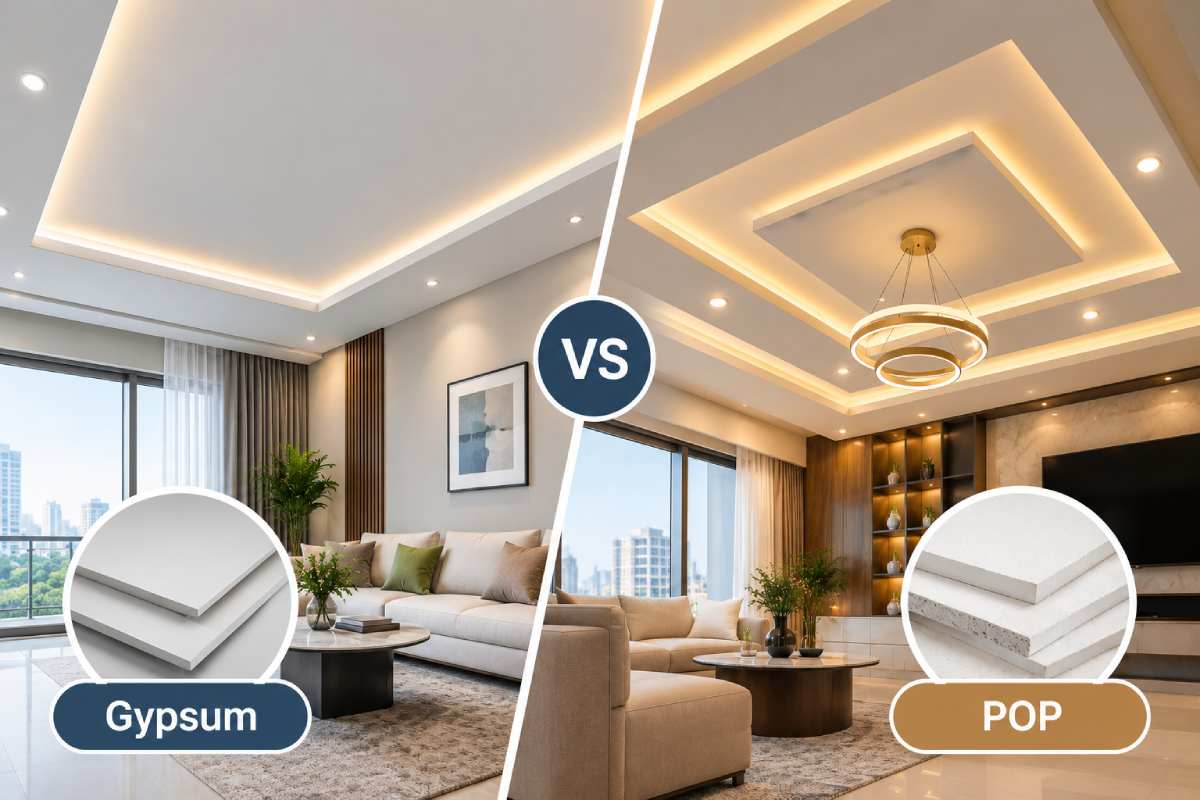
Most homeowners planning a ceiling in Thane eventually hear two different recommendations. One contractor suggests POP because it gives smooth curves and seamless finishes. Another suggests gypsum board because it is faster and cleaner. Both are valid materials, but they behave very differently on site, during the monsoon, and over years of use.
This guide explains the gypsum vs POP false ceiling decision the way a site team would. It covers how each material is installed, where each performs better, what affects false ceiling cost, and what to check before you hire a false ceiling contractor in Thane. By the end, you should be able to read two quotations and understand why they differ.
What Is a False Ceiling and Why Do Thane Homes Use It?
A false ceiling is a secondary ceiling built below the concrete slab, usually on a metal framework hung from the slab. The gap between the slab and the new ceiling hides electrical conduits, AC piping, drain lines, and sometimes uneven slab surfaces.
In Thane apartments, false ceilings are used for practical reasons as much as appearance. Older buildings often have uneven slabs, exposed beams, or visible conduit runs. Newer flats get ceilings for cove lighting, concealed AC units, and a cleaner look in the living room and bedrooms.
There are two common materials for residential work:
- POP (Plaster of Paris): Gypsum powder mixed with water on site and applied over a framework or directly on the slab. It sets into a hard, seamless surface.
- Gypsum board: Factory-made panels with a gypsum core between paper facings. These are screwed onto a galvanised iron (GI) frame, and the joints are taped and finished.
Both start from the same mineral, but the way they reach your ceiling is completely different. That difference drives everything else in the gypsum vs POP false ceiling comparison.
How a POP Ceiling Is Installed
A POP ceiling is built largely by hand. After marking the ceiling level, the team fixes a GI or metal framework to the slab. Chicken mesh, jute, or a similar base is attached to give the wet plaster something to grip. POP is then mixed in small batches and applied in layers, shaped and levelled by skilled workers.
Because POP is shaped while wet, it is excellent for curves, coves, domes, layered borders and decorative profiles. A skilled POP worker can create designs that would be difficult or expensive to achieve with boards. The finished surface has no visible joints.
The trade-offs come from the same process:
- Workmanship sensitivity: The final level, thickness, and finish depend heavily on the skill of the person applying it.
- Site mess and moisture: Wet work creates dust and debris, and the ceiling needs time to dry fully before primer and paint.
- Weight and thickness: POP layers can become heavy if they are applied too thick, which puts more load on the framework.
- Cracks from shortcuts: Hairline cracks usually come from a weak framework, poor mixing, too-fast drying, or movement in the slab above.
If you want to see typical designs, our POP design ideas guide shows common residential profiles.
How a Gypsum Board Ceiling Is Installed
A gypsum board ceiling is a dry, system-based installation. The team fixes perimeter channels along the walls at the marked level. Intermediate channels are then hung from the slab using anchor fasteners and soffit cleats, and ceiling sections are clipped across them to form a grid. Boards are screwed to this grid, and the joints are taped and filled with jointing compound before sanding and painting.
This method gives a consistent level across large areas. Because the boards are manufactured to a fixed thickness, the surface is uniform, and the work moves faster than wet POP. There is also far less mess, which matters in an occupied flat or a building with strict society rules about debris.
The limitations are different from POP:
- Curves need extra work: Boards are flat. Curves are possible with flexible boards or cut profiles, but complex shapes take more labour.
- Joints must be finished well: Poorly taped joints are the most common cause of visible lines or cracks in a gypsum board ceiling.
- Board choice matters: Standard boards are not suitable for wet areas. Moisture-resistant boards should be specified for kitchens and bathrooms.
Gypsum vs POP False Ceiling: Side-by-Side Comparison
The table below summarises how the two materials compare on the points homeowners usually ask about.
| Factor | POP ceiling | Gypsum board ceiling |
|---|---|---|
| Installation method | Wet, hand-applied on site | Dry, boards screwed to a GI grid |
| Finish | Seamless, no joints | Joints taped and finished |
| Curves and decorative work | Very flexible | Possible, but more labour for complex shapes |
| Site mess | High (mixing, dust, debris) | Lower |
| Speed | Slower, needs drying time | Faster for flat ceilings |
| Consistency | Depends heavily on worker skill | More uniform because boards are factory-made |
| Repairs | Patch repair by skilled hand | Damaged board section can be cut out and replaced |
| Wet areas | Not ideal unless well protected | Use moisture-resistant boards |
| Typical use in Thane flats | Decorative living rooms, coves, borders | Bedrooms, offices, large flat ceilings |
Neither material wins on every row. The right answer in a gypsum vs POP false ceiling decision depends on the design you want, how quickly the work must finish, and how much site disruption you can accept.
Durability: Which Ceiling Lasts Longer?
Durability depends less on the material and more on three things: the framework, the workmanship, and what happens above the ceiling.
A POP ceiling with a strong framework, correct mixing, and proper drying can last many years without trouble. A gypsum board ceiling with properly spaced channels, the right screws, and well-finished joints can do the same.
Most failures we see in older homes trace back to one of these causes:
- Water leakage from above: A leaking slab, bathroom, or AC drain line soaks the ceiling. Both materials lose strength and stain when wet.
- Weak hangers or wide spacing: The ceiling sags between supports over time.
- Fast or shortcut finishing: Painting POP before it dries, or skipping joint tape on gypsum, leads to cracks.
- Heavy fixtures on the ceiling alone: Chandeliers or fans fixed only to the ceiling surface, instead of the slab, cause damage.
This is why we always recommend fixing leakage before any ceiling work. If the slab above shows dampness, read our guide on waterproofing services before you finalise the ceiling design.
Monsoon and Moisture: A Thane-Specific Concern
Thane gets heavy monsoon rainfall, and many buildings have older terraces or bathrooms above living spaces. Moisture is the biggest enemy of any false ceiling here.
In top-floor flats, check the terrace waterproofing before installing a ceiling. In middle floors, check the bathroom above for leakage, especially around the floor trap and concealed pipes. A ceiling built under an active leak will stain within one monsoon, regardless of whether it is a POP ceiling or a gypsum board ceiling.
For kitchens and bathrooms, moisture-resistant gypsum boards are generally the safer choice. Plain POP in a bathroom ceiling is risky unless ventilation is good and the surface is properly sealed and painted.
What Affects False Ceiling Cost?
We do not quote a single per-square-foot figure here, because false ceiling cost changes significantly with scope. Two quotations for the same room can differ for good reasons.
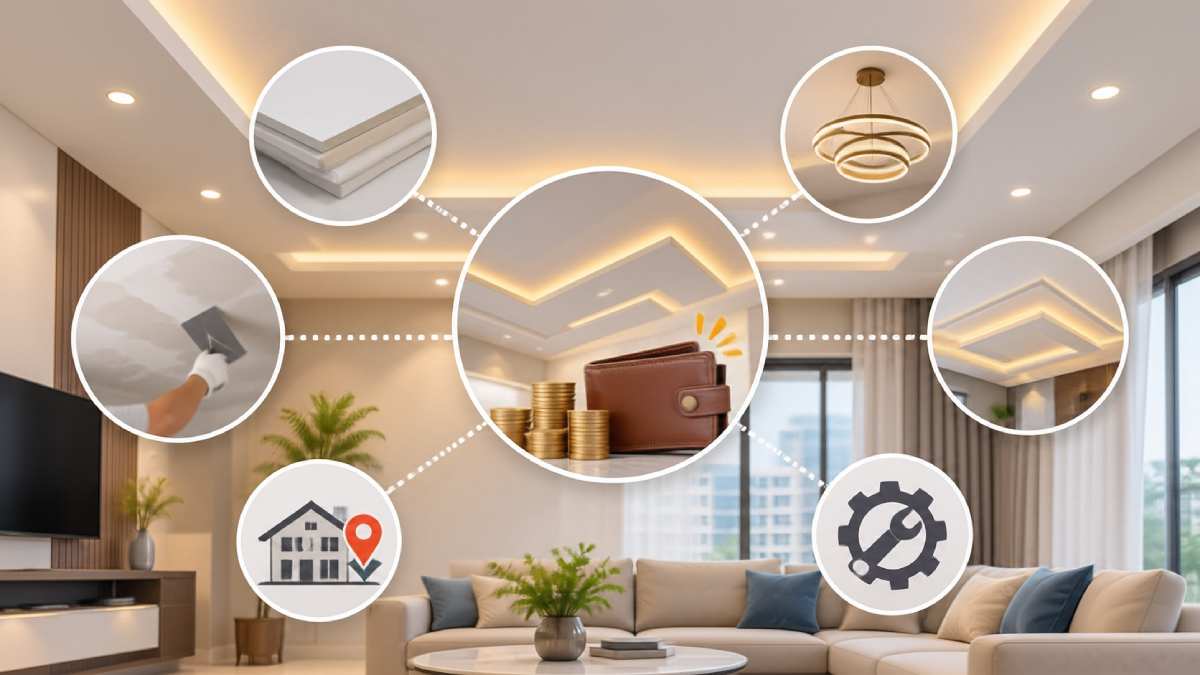
These are the main cost factors:
| Cost factor | Why it matters |
|---|---|
| Material type | POP and gypsum board have different material and labour profiles |
| Design complexity | Coves, layers, curves and borders take far more labour than a flat ceiling |
| Framework specification | Channel thickness, spacing and brand affect both cost and strength |
| Board grade | Moisture-resistant or fire-rated boards cost more than standard boards |
| Ceiling height and access | High ceilings need scaffolding, and access limits slow the work |
| Lighting and cut-outs | Each light, AC grille, and access panel adds cutting and finishing work |
| Existing ceiling removal | Breaking an old ceiling adds demolition and debris disposal |
| Painting and finishing | Primer, putty, and paint may or may not be included |
| Society restrictions | Limited working hours and lift booking can extend the timeline |
When you compare quotations, ask whether each one includes framework specification, finishing, painting, electrical cut-outs, and debris removal. A lower false ceiling cost often means something has been left out.
Electrical, AC and Lighting Coordination
A false ceiling is not only a finishing job. It hides services, so it must be planned with the electrician and AC installer before the boards or plaster go up.
Before ceiling work starts, confirm the positions of every light, fan, AC unit, smoke detector, and speaker. Conduits should be laid and tested, and AC copper piping and drain lines should be pressure-checked. Provide access panels where valves, junction boxes, or AC drains need future servicing.
Cove lighting needs a correctly sized cove profile so the LED strip is hidden and the light spreads evenly. If you are rewiring at the same time, coordinate with the electrical work team so wiring is complete before the ceiling closes.
Which One Should You Choose?
For most Thane flats, the practical answer is a combination rather than one material everywhere.
- Choose a POP ceiling: For living rooms or feature areas where you want curves, decorative borders, or seamless coves, and where you can accept more drying time.
- Choose a gypsum board ceiling: For bedrooms, offices, and large flat areas where speed, uniformity, and less mess matter.
- Choose moisture-resistant gypsum boards: For kitchens and bathrooms.
- Skip the ceiling in some rooms: If the slab is even and you do not need concealed services. Not every room needs a false ceiling.
The gypsum vs POP false ceiling choice should follow the design, the room's use, and the condition of the slab above, not a fixed preference.
Common Mistakes to Avoid
- Installing the ceiling before fixing leaks: The new ceiling will stain and weaken.
- Not fixing heavy fans and lights to the slab: The ceiling surface is not designed to carry that load.
- No access panels: Servicing an AC drain or junction box later means breaking the ceiling.
- Painting too early: POP must be fully dry before primer and paint.
- Choosing on design images alone: A design that looks good in a photo may not suit your ceiling height.
- Accepting vague quotations: Ask for framework specification, board brand and grade, and finishing scope in writing.
How to Choose a False Ceiling Contractor in Thane
When you evaluate a false ceiling contractor in Thane, look beyond design photos. Ask these questions:
- Will someone inspect the slab for dampness and unevenness before quoting?
- What framework will be used, and at what spacing?
- Which board brand and grade, or which POP product, is included?
- Are electrical cut-outs, cove profiles, and access panels included?
- Is putty, primer, and paint part of the scope?
- How will debris be handled under society rules?
- What happens if cracks appear after handover?
A reliable false ceiling contractor in Thane will answer these in writing. If the answers are vague, the risk of cracks, sagging, or extra charges later is higher.
Eagle Ventures Project Insight
In a residential flat at Kapurbawdi, Thane West, the homeowner was deciding between POP and gypsum for a 2BHK renovation. During the initial site inspection, our team checked the ceiling slab for signs of dampness from the floor above and found it sound and level.
For the living room, where the homeowner wanted indirect cove lighting and smooth, curved corner profiles, our team installed a high-grade POP false ceiling on a heavy-gauge GI framework.
For the bedrooms and passage, we installed factory-made gypsum boards on suspended metal grids, with joints taped and finished using a manufacturer-approved gypsum jointing compound.
This hybrid approach achieved the desired curved aesthetic in the main living area while reducing installation time and on-site mess in the bedrooms and passage.
Electrical wiring was planned before ceiling installation, while fan rods and chandelier anchors were independently secured to the concrete slab rather than supported by the false ceiling. This approach helps improve structural stability and reduce the risk of ceiling sagging over time.
How Eagle Ventures Can Help
Eagle Ventures handles POP and false ceiling work as part of civil and interior execution in Thane. That includes site inspection, slab condition checks, framework installation, POP or gypsum finishing, and coordination with electrical work. You can see the scope on our POP and false ceiling service page. If you are unsure which material suits your flat, arrange a site assessment and request an itemised quotation.
Frequently Asked Questions
1. Which is better in the gypsum vs POP false ceiling choice for a living room?
POP is usually better when you want curves, layered borders, or seamless coves. Gypsum board is better when you want a flat, uniform ceiling installed quickly with less mess.
2. Does a POP ceiling crack easily?
Not if it is installed correctly. Cracks usually come from a weak framework, poor mixing, painting before it dries, or water leaking from the slab above.
3. Can gypsum board be used in a bathroom?
Use moisture-resistant gypsum boards in bathrooms and kitchens, with good ventilation. Standard boards should not be used in wet areas.
4. How long does false ceiling work take for a 2BHK?
It depends on design complexity, the material, and society working hours. A flat gypsum board ceiling usually moves faster than a detailed POP ceiling, which needs drying time.
5. What affects false ceiling cost the most?
Design complexity, framework specification, board grade, the number of lights and cut-outs, and whether painting and old ceiling removal are included.
6. Can a damaged ceiling be repaired without replacing it fully?
Often, yes. A damaged gypsum board section can be cut out and replaced. A POP ceiling can be patch-repaired by a skilled worker once the cause of the damage is fixed.
7. Should I fix leakage before installing a false ceiling?
Yes. Any dampness in the slab above will damage a new ceiling within one monsoon.
Conclusion
The gypsum vs POP false ceiling decision is not about which material is better overall. It is about matching the material to the room, the design, and the site condition. POP suits decorative, seamless work. Gypsum board suits fast, uniform, and cleaner installation. Both last when the framework is sound, the finish is done patiently, and the slab above is dry.
If you are planning a ceiling in Thane, discuss your requirement with Eagle Ventures. We can inspect the site, check for moisture, and prepare an itemised quotation for the option that suits your home.
You May be Interested in
-
 October 15, 2026
Commercial Office Renovation in Thane: Cost, Timeline, Design & Execution Guide
Commercial office renovation is often necessary when a business outgrows its existing workspace...
Read More... -
 January 21, 2026
POP Work for Homes in Thane: Cost, Designs & Common Failure Reasons
POP work is one of the most common interior upgrades in homes today. Learn what drives costs and prevents cracks...
Read More... -
 September 10, 2025
Best POP Work & Ceiling Design Ideas for Homes, Galleries, and Offices | 2025 Guide
Explore inspiring ceiling designs, layered borders, cove lighting ideas, and profile details for contemporary homes...
Read More...
FREE CONSULTATION
Talk To Our Expert

About Eagle Ventures
Eagle Ventures is one of the leading interior designers, civil contractors, and renovation specialists in Thane, providing high-quality residential and commercial interior solutions.
Contact Details
- Nisha Glass House, Opp Goenka International School, Kapurbawdi, Thane West - 400607
- +91 96999 29056
- eagleventures17@gmail.com